Saturday, January 31, 2009
Wednesday, January 28, 2009
artsy fartsy: part 2
Labels:
children's art projects

Tuesday, January 27, 2009
artsy fartsy: part I
First of all, I'm not sure if "fartsy" is an appropriate term in blogland. It would definitely not go over well in preschool - "Potty words belong in the bathroom," as we like to say around here. Oh well, you can't blame a girl for rhyming!
Anyway, we have a few totally splendid art lessons out in the classroom right now, and I can't wait to share them with you!
Wouldn't you love to have something hanging in your house like this?
It's almost more fun to make than it is to look at,
can you believe it?
What you'll need:
paper
liquid water color
eyedroppers
straws cut into 3in lengths

Anyway, we have a few totally splendid art lessons out in the classroom right now, and I can't wait to share them with you!
It's almost more fun to make than it is to look at,
can you believe it?
What you'll need:
paper
liquid water color
eyedroppers
straws cut into 3in lengths
FYI: The straws are kept in that spice shaker that you see on the tray. The child shakes one out of the large opening side without touching all of the other straws - always trying to prevent germ contamination around here!
The child uses the eyedropper to apply tiny pools of liquid water color to the paper.
He then uses his straw to blow the watercolor across the paper, and in the process creates a beautiful mix of colors.
The child uses the eyedropper to apply tiny pools of liquid water color to the paper.
Please note:
I also wanted to tell you that this lesson goes beyond strengthening fine motor control. I wish I could be more specific, but I'll give it my best try. We've had people certified in H.A.N.D.L.E. work with children in our classroom in the past, and they've suggested activities that involve blowing things around with the mouth.
I copied this description of "blow soccer" from the H.A.N.D.L.E. website:
I also wanted to tell you that this lesson goes beyond strengthening fine motor control. I wish I could be more specific, but I'll give it my best try. We've had people certified in H.A.N.D.L.E. work with children in our classroom in the past, and they've suggested activities that involve blowing things around with the mouth.
I copied this description of "blow soccer" from the H.A.N.D.L.E. website:
Because it works on so many different areas, this activity helps to develop numerous functions, among them articulation, facial affect (expressions), reading, copying skills, listening, mental focus, balance, language acquisition, bowel and bladder control, and endurance.
Read more here.
Read more here.
Labels:
children's art projects

Monday, January 26, 2009
hittin' the books
Hey! Guess what? I'm going back to school! Yikes! It's actually not quite as intense as it sounds... I just need to take a 3 credit university course, so I can keep my elementary ed. teaching certification. The class is online and it's called "Applications of Children's and Young Adult Literature." Just about everyone in the class is a public school librarian... hmmm... so I fit right in, right? Don't worry, I'm going to do my darndest to put a Montessori twist on the whole thing. As part of the class, I need to read 5 children's books a week, critique them, and come up with classroom extension activities. Oh, and it is supposed to be done in less than 200 words. I'm not really convinced that that's possible. 5 books? 200 words? Geez. I'm posting my first assignment for your reading pleasure. We're studying South America in the (Montessori) classroom right now, so that's what influenced my reading choices. Please, if you have any book recommendations for me for future assignments, do share! Also, I won't hold it against any of you if you skip this semi-studious post. :)
Title: Jabuti the Tortoise: A Trickster from the Amazon
Author: Gerald McDermont
Response: This legend explains how the birds of the Amazon became so colorful. At first glance, I know that the children in my class will love the illustrations in this legend because they’re bold and colorful. The main character, Jabuti, is a tiny tortoise, and they are forever into small things, especially animals. I do think they will be fairly upset and worried when the vulture drops Jabuti from the sky, and his shell becomes shattered on the ground.
Classroom extensions: I would create a vocabulary lesson with the words toucan, macaw, hummingbird, etc. Readers could practice matching labels to pictures. Non-readers could play matching games with pictures. Also, children could identify colors on the birds, and then look for those colors around the classroom.

Title: The Great Kapoke Tree: A Tale of the Amazon Rain Forest
Author: Lynee Cherry
Response: In this story, a man enters the rain forest to chop down a Kapoke tree. Before he cuts it down, he drifts asleep. All of the rain forest animals each visit him to beg him not to cut down the tree. I think the children will be on the edge of their seats. They love all the animals in the pictures, and they’ll root for the man not to cut down the tree.
Classroom extension: This book would lead into a great discussion about paper coming from trees. If we are wasteful of paper towels, toilet paper, and writing paper , more trees like the wise Kapoke tree will live in danger of being chopped down.

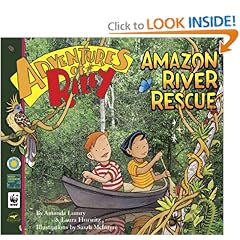
Title: Adventures of Riley: Amazon River Rescue
Author: Amanda Lumry & Laura Hurwitx
Response: In this story, two children take a trip to the Amazon. Many interesting facts about the rain forest and the animals it is home to are included in the text, as-well-as fun dialogue between the characters. Overall, it’s very engaging. Depending on the child, you could just read the dialogue, or you could read the fact boxes on the side, too.
Classroom extension: I think it would be fun to make a rain forest environment on a tray with plants, animals, and water. This would provide the child with both a concrete and imaginative experience. Also, children could look for rain forest animals in old National Geographic’s to cut out and put in a collage. It would also be nice to make two sets of cards, some with pictures from the Amazon rain forest and some with pictures of North American forests, and the children could sort them.

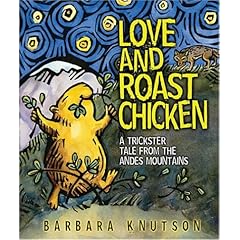
Title: Love and Roast Chicken: A Trickster Tale from the Andes Mountains
Author: Barbara Knutson
Response: This book tells the story of a guinea pig who like to play tricks and a fox who wants to eat him.
Of all the books, I think this one will be the most fun to read out loud because the dialogue between the characters is so natural and funny.
Classroom extension: There are a lot of Spanish phrases in this book, so I would use some of them in Spanish vocabulary games at circle time.

Title: Deep in a Rainforest
Author: Gwen Pascoe
Response: This book of colors in the rain forest has few words, but beautiful pictures.
Classroom extension: I would have children sort images from the book by color. Children could also label the colors. I would write the words in color to guarantee even the non-readers’ success (for example, blue would be blue).
Title: Jabuti the Tortoise: A Trickster from the AmazonAuthor: Gerald McDermont
Response: This legend explains how the birds of the Amazon became so colorful. At first glance, I know that the children in my class will love the illustrations in this legend because they’re bold and colorful. The main character, Jabuti, is a tiny tortoise, and they are forever into small things, especially animals. I do think they will be fairly upset and worried when the vulture drops Jabuti from the sky, and his shell becomes shattered on the ground.
Classroom extensions: I would create a vocabulary lesson with the words toucan, macaw, hummingbird, etc. Readers could practice matching labels to pictures. Non-readers could play matching games with pictures. Also, children could identify colors on the birds, and then look for those colors around the classroom.

Title: The Great Kapoke Tree: A Tale of the Amazon Rain Forest
Author: Lynee Cherry
Response: In this story, a man enters the rain forest to chop down a Kapoke tree. Before he cuts it down, he drifts asleep. All of the rain forest animals each visit him to beg him not to cut down the tree. I think the children will be on the edge of their seats. They love all the animals in the pictures, and they’ll root for the man not to cut down the tree.
Classroom extension: This book would lead into a great discussion about paper coming from trees. If we are wasteful of paper towels, toilet paper, and writing paper , more trees like the wise Kapoke tree will live in danger of being chopped down.

Title: Adventures of Riley: Amazon River Rescue
Author: Amanda Lumry & Laura Hurwitx
Response: In this story, two children take a trip to the Amazon. Many interesting facts about the rain forest and the animals it is home to are included in the text, as-well-as fun dialogue between the characters. Overall, it’s very engaging. Depending on the child, you could just read the dialogue, or you could read the fact boxes on the side, too.
Classroom extension: I think it would be fun to make a rain forest environment on a tray with plants, animals, and water. This would provide the child with both a concrete and imaginative experience. Also, children could look for rain forest animals in old National Geographic’s to cut out and put in a collage. It would also be nice to make two sets of cards, some with pictures from the Amazon rain forest and some with pictures of North American forests, and the children could sort them.

Title: Love and Roast Chicken: A Trickster Tale from the Andes Mountains
Author: Barbara Knutson
Response: This book tells the story of a guinea pig who like to play tricks and a fox who wants to eat him.
Of all the books, I think this one will be the most fun to read out loud because the dialogue between the characters is so natural and funny.
Classroom extension: There are a lot of Spanish phrases in this book, so I would use some of them in Spanish vocabulary games at circle time.

Title: Deep in a Rainforest
Author: Gwen Pascoe
Response: This book of colors in the rain forest has few words, but beautiful pictures.
Classroom extension: I would have children sort images from the book by color. Children could also label the colors. I would write the words in color to guarantee even the non-readers’ success (for example, blue would be blue).

Sunday, January 25, 2009
passing around a little blog love
Jo at a bit of this and a bit of that gave me this award a few weeks ago, and it's high time that I pass it on! I just want to add that the blog world has changed my life! :) Honestly, at this time last year I was totally in the dark about all the incredible ideas and inspiration being shared online among teachers, mamas, and other fab individuals! Yay! I'm so happy to be here!
Here are the details of the award:
This award is given to a blog that invests and believes in PROXIMITY - nearness in space, time and relationships! These blogs are exceedingly charming. These kind of bloggers aim to find and be friends. They are not interested in prizes or self-aggrandizement. Our hope is that when the ribbons of these prizes are cut, even more friendships are propagated. Please give more attention to these writers!
So, in no particular order, the 8 blogs I'm passing the award to are...
Organizing the Jellybeans
The Wonder Years
Making of a Montessori Mum
A Day of Wonders
My Child's Diary
Live,Laugh, Love, be Happy
Adventures of a Rainbow Mama
Modern 50's Housewife
Enjoy!
Here are the details of the award:This award is given to a blog that invests and believes in PROXIMITY - nearness in space, time and relationships! These blogs are exceedingly charming. These kind of bloggers aim to find and be friends. They are not interested in prizes or self-aggrandizement. Our hope is that when the ribbons of these prizes are cut, even more friendships are propagated. Please give more attention to these writers!
So, in no particular order, the 8 blogs I'm passing the award to are...
Organizing the Jellybeans
The Wonder Years
Making of a Montessori Mum
A Day of Wonders
My Child's Diary
Live,Laugh, Love, be Happy
Adventures of a Rainbow Mama
Modern 50's Housewife
Enjoy!

Friday, January 23, 2009
ask annie, aka Mrs. L, aka itty bitty love
I recently received an e-mail from a homeschooling mama who's setting up some Montessori inspired activities for her 2-year-old daughter. She asked me about cylinder blocks and geometric solids - which was easy enough to answer. And then, she asked me this: "Are there any other Montessori materials that would be beneficial if purchased for home use?" Yikes! I ended up writing her a whole book! :) Once I get going on Montessori, it's a little hard for me to stop... Anyway, I decided to post my response on here, in case any of you are interested. I would love to hear your thoughts on the matter, too!
1. Coordination and Control of Movement (Practical Life)
Most practical life activities can be put together with things you probably already have in your house and treasures you can find at thrift stores and garage sales. Since your daughter is 2, I would probably suggest activities like these:
-scooping rice from one dish to another
-squeezing water with a sponge between two bowls
-find a container (coffee can, yogurt, etc), cut a hole in the lid, and put together some objects that can be pushed through it
-stick a chopstick to a tray with a ball of clay, and have your daughter *string* the chopstick with chunky beads
The possibilities for practical life activities are endless! Usually you can just follow your child's natural interests, but do keep in mind that the purpose of these exercises is to strengthen motor control and develop a sense of order and independence.
2. Sensorial
The Sensorial activities are quite a bit harder to put together without buying a lot of materials. Their purpose is to help your child refine her senses by isolating one particular quality at a time. For example, the knobbed cylinders are all made of the same kind of wood and all have the same knobs on top; they only differ in height and diameter. If I were you, I would go for the mini knobbed cylinders - I've never used them, but they're significantly cheaper and they look like they achieve the same purpose. As for the for the geometric solids, that's great if you can put your own set together. In my classroom, we usually work with a set of 6 - cylinder, cone, cube, sphere, rectangular prism, and ovoid. These work the best for us because they're all fairly easy to find in the environment. I'll be honest, though, they are not especially popular with the children. We have a set of cards that have pictures of things like balls, blocks, cans, and eggs, and the children will match them to the geometric solids sometimes. Otherwise, they rarely get used unless a teacher is directing the activity.
These sensorial activities tend to get used the most:
-the pink tower
-the broad stair
-the knobbed cylinders
Mystery bags and fabric matching are also popular, and you can put them together yourself. -Mystery bags are cloth bags that contain objects you can identify or match by "seeing with your hands."
-Fabric matching involves matching pairs of fabrics that vary in texture by touch alone.
Basically, just keep in mind that your purpose is to refine the senses. There are a lot of activities out there that accomplish this without involving "official" Montessori materials. For example:
-make different sounds and have your daughter guess what they are (example: ring a bell, whistle, clap,laugh, unzip something, etc).
-taste test salty, sweet, and sour by filling eyedroppers with sugar water, salt water, and lemon water
-match smells like citrus, peppermint, and cinnamon by putting drops of essential oils on cotton balls in jars
Oh, one more thing! This is what I was taught about the sensorial materials: the child should have the experience first - without language. Later on you can give her the names (for example, loud and soft). I find that this varies with each child - many already know the names, and sometimes it just feels natural to add them into the conversation. Next comes matching, then grading, and finally, the language that goes along with grading (big, bigger,biggest).
As for math and langauge (can you tell I'm running out of steam?), they're pretty straightforward for little ones. 3-year-olds are the youngest children in my classroom, and the majority of them spend most of their time in the practical life and sensorial areas of the classroom. What I would suggest for a 2-year-old is simple (please correct me here if I'm wrong!) - be conscious that you're speaking in a clear voice with real words, play "I spy" and games that involve matching, and model making a 1-1 correspondence between numbers and objects when you count things out.
The end!
x.
Most practical life activities can be put together with things you probably already have in your house and treasures you can find at thrift stores and garage sales. Since your daughter is 2, I would probably suggest activities like these:
-scooping rice from one dish to another
-squeezing water with a sponge between two bowls
-find a container (coffee can, yogurt, etc), cut a hole in the lid, and put together some objects that can be pushed through it
-stick a chopstick to a tray with a ball of clay, and have your daughter *string* the chopstick with chunky beads
The possibilities for practical life activities are endless! Usually you can just follow your child's natural interests, but do keep in mind that the purpose of these exercises is to strengthen motor control and develop a sense of order and independence.
The Sensorial activities are quite a bit harder to put together without buying a lot of materials. Their purpose is to help your child refine her senses by isolating one particular quality at a time. For example, the knobbed cylinders are all made of the same kind of wood and all have the same knobs on top; they only differ in height and diameter. If I were you, I would go for the mini knobbed cylinders - I've never used them, but they're significantly cheaper and they look like they achieve the same purpose. As for the for the geometric solids, that's great if you can put your own set together. In my classroom, we usually work with a set of 6 - cylinder, cone, cube, sphere, rectangular prism, and ovoid. These work the best for us because they're all fairly easy to find in the environment. I'll be honest, though, they are not especially popular with the children. We have a set of cards that have pictures of things like balls, blocks, cans, and eggs, and the children will match them to the geometric solids sometimes. Otherwise, they rarely get used unless a teacher is directing the activity.
These sensorial activities tend to get used the most:
-the pink tower
-the broad stair
-the knobbed cylinders
-Fabric matching involves matching pairs of fabrics that vary in texture by touch alone.
Basically, just keep in mind that your purpose is to refine the senses. There are a lot of activities out there that accomplish this without involving "official" Montessori materials. For example:
-make different sounds and have your daughter guess what they are (example: ring a bell, whistle, clap,laugh, unzip something, etc).
-taste test salty, sweet, and sour by filling eyedroppers with sugar water, salt water, and lemon water
-match smells like citrus, peppermint, and cinnamon by putting drops of essential oils on cotton balls in jars
Oh, one more thing! This is what I was taught about the sensorial materials: the child should have the experience first - without language. Later on you can give her the names (for example, loud and soft). I find that this varies with each child - many already know the names, and sometimes it just feels natural to add them into the conversation. Next comes matching, then grading, and finally, the language that goes along with grading (big, bigger,biggest).
As for math and langauge (can you tell I'm running out of steam?), they're pretty straightforward for little ones. 3-year-olds are the youngest children in my classroom, and the majority of them spend most of their time in the practical life and sensorial areas of the classroom. What I would suggest for a 2-year-old is simple (please correct me here if I'm wrong!) - be conscious that you're speaking in a clear voice with real words, play "I spy" and games that involve matching, and model making a 1-1 correspondence between numbers and objects when you count things out.
The end!
x.
Labels:
Montessori - General

Thursday, January 22, 2009
my view from the couch
Not at school, but on the couch. I haven't been able to move my head since Tuesday, so I decided it was high time to stop feeling like a robot and get some rest..Those of you who know me know that I do not like to take sick days, only powder days.
Anyway, I spent my whole day in this room. It's our new media room. Sorry, I'm not trying to have a pity party! I just thought you might be curious to know that I have a giant car painting in my house. To make it even more interesting, my mother-in-law is the artist who painted it. Pretty wild, huh?
You're probably wondering where the media room gets its name. Hmmm... should I tell you? Okay, I'll be honest, there's a large, flat screen tv hanging on one of the walls. My brother-in-law gave it to us last month as a wedding/Christmas present.
I've always been proud to live in a tv-free house, and suddenly I've become the partial owner of a much larger than I would have chosen television.
Of course, hubs is 100% in love with it, and of course, I had to stomp my feet so that it wouldn't get hung above the fireplace!
As a compromise, we decided to turn the back bedroom of our house into a media room. We only get one scratchy PBS channel, so we haven't totally lost our souls to television yet. And, for those of you who were wondering, I'm still cellphone and microwave-free! I'm not quite plastic-free, but I'm working on it.
My heart goes out to all of you that suffer from back and neck problems on a regular basis - I now know your pain! As much fun as I've had staring at this giant car all day, I definitely would have rather been at school!
Labels:
home sweet home

Wednesday, January 21, 2009
my new favorite game (the children dig it, too)
Here's the gist of it:
You have a child who's at a practicing point in his educational experience. For example, he's got a pretty good understanding of the symbols 1-9 and their quantities, but he doesn't have them quite mastered yet. Or, she knows her letter sounds, and she's really into identifying letter symbols. Maybe, he can match and name colors, but he's not exactly ready to grade them from darkest to lightest. Oh! The possibilities for this game are endless!
Ooops! Back to the gist of it:
Basically, this game is a variation of lessons the child has already done. It's like extreme matching...
Here, the child has set out the numerals from "numerals and counters" on a rug. The counters in this particular lesson are pigs, and we have placed them in a tin on a table across the room. Because I know she knows her number symbols, I point to the 8 and say, "Please bring me this many pigs." If I wasn't sure she was sure of the symbol, I might say, "Please bring me 8 pigs."
It's a fun challenge for the child to be able to go across the room and count out the right quantity of pigs to bring back to the rug.
Here's another variation of the game. A few children and I have placed letter cards on the blue line. The cards are like little books - the letter is on the cover, and inside is a picture of something that begins with that letter. Anyway, I sit across the room, far away from the blue line. I ask each child I'm playing with to bring me a letter (by sound not by name). For example, "Please bring me e." This game would work well at home, too - you could set the cards up in the living room, and then, as you cooked dinner or something, you could ask your child to bring you back certain letters.
This game can be played with all kinds of materials...
color tablets, rhyming objects, matching fabric, sound cylinders...seriously, aren't the possibilities endless?!
Doesn't it sound fun? It is! And, I forgot to say this earlier, it's perfect for the child who just needs to move!
You have a child who's at a practicing point in his educational experience. For example, he's got a pretty good understanding of the symbols 1-9 and their quantities, but he doesn't have them quite mastered yet. Or, she knows her letter sounds, and she's really into identifying letter symbols. Maybe, he can match and name colors, but he's not exactly ready to grade them from darkest to lightest. Oh! The possibilities for this game are endless!
Ooops! Back to the gist of it:
Basically, this game is a variation of lessons the child has already done. It's like extreme matching...
This game can be played with all kinds of materials...
color tablets, rhyming objects, matching fabric, sound cylinders...seriously, aren't the possibilities endless?!
Doesn't it sound fun? It is! And, I forgot to say this earlier, it's perfect for the child who just needs to move!
Labels:
Montessori - Language,
Montessori - Math

Tuesday, January 20, 2009
"For as much as government can do and must do, it is ultimately the faith and determination of the American people upon which this nation relies...
{it is} a parent's willingness to nurture a child, that finally decides our fate." President Obama
What if every little child learned how to be tolerant of those different from himself? Would we be in this mess at all?
Hmmm... NO!
If only they could all just go to Montessori school...
Maria Montessori's philosophy of education is so powerful to our culture because, academics aside, peace has and always will be at its heart.
Labels:
peace

Friday, January 16, 2009
busy hands
Oh yes, the classroom has been a busy place during these weeks after Christmas break! I expected things to be a little crazy... like not in a good way crazy. I was totally wrong. Our classroom feels more normal and productive than ever. The children came back embracing the routine. They've eagerly practiced all their favorite lessons, and have happily watched us teachers present them with new ones. Everyday, I've gone home feeling awed by all of them. How did they become so mature in those two weeks they were away from me?! So many of them are becoming expert readers, writers, counters, and nutcrackers. I've barely had time to grab my camera!
Here's the one I made for my classroom.
It has been getting some serious love.
sorting tiny objects by theirbeginning sounds
I talked about this lesson here.
Labels:
Montessori - busy hands

Thursday, January 15, 2009
a much loved art lesson
in our classroom right now.
Seriously.
If you're wondering how it's done,
just glue squares of foam
(construction paper would work, too)
onto a paper grid.
How simple is that?!
But it's fabulous -

Everybody who's anybody
is busy making a mosaic during the work period.
If you're wondering how it's done,
just glue squares of foam
(construction paper would work, too)
onto a paper grid.
How simple is that?!
But it's fabulous -
because the child is improving
her fine motor skills
by using a paintbrush or a glue stick
(most choose the paintbrush method)
to stick a square
onto a paper grid.
Also, the child is developing his creativity
because he can make
whatever patterns he desires.
This lesson
could possibly be titled
Mosaic 101.
her fine motor skills
by using a paintbrush or a glue stick
(most choose the paintbrush method)
to stick a square
onto a paper grid.
Also, the child is developing his creativity
because he can make
whatever patterns he desires.
This lesson
could possibly be titled
Mosaic 101.
Labels:
children's art projects

Wednesday, January 14, 2009
a spoonful of couscous...
If you haven't checked out The Wonder Years yet, you should. I love catching glimpses of this Montessori mama's home-based classroom. She's got a good thing
going on.
The inspiration for this measuring lesson came from her - check it out here.going on.
The child spoons couscous
using a spreader to level off his scoops.
There is a small dish for each spoonful,
so the child is able to see the differences
in volume of the measuring spoons.
There is a small dish for each spoonful,
so the child is able to see the differences
in volume of the measuring spoons.
of couscous in each smaller dish,
he pours it all back into the main dish.
Later on, I will introduce the language 1/4 teaspoon, 1/2 teaspoon, and 1 teaspoon.
These measuring spoons could also be used in math activities... children could discover how many 1/4 teaspoons would fill 1 teaspoon or something.
A control of error for this lesson would be to fill the main dish with just enough couscous to fill each measuring spoon. Right now, our measuring lesson doesn't have this control of error. It's sort of an experimental experience for the child. I think I like it that way!
These measuring spoons could also be used in math activities... children could discover how many 1/4 teaspoons would fill 1 teaspoon or something.
A control of error for this lesson would be to fill the main dish with just enough couscous to fill each measuring spoon. Right now, our measuring lesson doesn't have this control of error. It's sort of an experimental experience for the child. I think I like it that way!
Labels:
Montessori - Practical Life

Tuesday, January 13, 2009
Monday, January 12, 2009
last call for the phonemic object swap!
**you must collect 2 sets of 10 tiny objects (2-10 cm) that begin with sounds from the alphabet
**each participant gets two swap partners, so that means everyone ends up with 20 objects
If this swap sounds like just the thing for you and your little one(s), check it out here.
I'm pretty much beyond excited about this swap. Tiny objects are so dang hard to find sometimes, especially if your goal is to find a few for each letter of the alphabet. Honestly, you can never have too many tiny objects handy to use in language games.
Jo has a great picture in her post of the sound pouches she made. It's really beautiful, and you can click on each letter to see what objects she has in each pouch. In my classroom, we have an alphabet box with a drawer for each letter of the alphabet. Each drawer contains tiny objects that start with that letter of the alphabet. This lesson provides great practice for sound/symbol association. Sometimes children take out one drawer and just look at the objects. Other times, they might take objects from two or three drawers, mix them up, and then sort them by sound. The children in my classroom are really into doing this right now, and they often choose to take out the corresponding sandpaper letters, too. If you don't have something like an alphabet box or sound pouches set up, and you want to make one, this swap would be a good place to start.
Also, tiny objects like these are great to use in "I spy" games, beginning sound games, blending games, and word building activities.
And, hey, maybe you'll get to be my swap partner and I'll send you one of these teeny "h-hats" I've been knitting!
Labels:
homemade materials,
Montessori - Language

Subscribe to:
Posts (Atom)