Pages

Showing posts with label Montessori - Language. Show all posts

Thursday, September 24, 2015

introducing the alphabet, Montessori-style


The ability to isolate a beginning sound of a word is the point of readiness for learning the alphabet letter sounds.
- Randall Klein, Montessori teacher and early reading specialist

For the past several months, 
I have been gradually introducing Elise 
to the letters of the alphabet.

Before that, we played LOTS of language games
- and still do! -
like "I spy," the blending game, and matching.

How did I know Elise was ready to make the leap to letters?

First, I noticed that her phonemic awareness was growing,
and that she was able to identify the beginning sounds of most words.

Second, I couldn't deny her curiosity about letters any longer!
I had already casually told her the sounds of a few letters,
and she soaked them up like a sponge.

I really wanted her to learn the letter sounds,
and I realized that if I didn't act quickly,
the rest of the world was going to teach her the names first!


Once I decided to go for it,
the first thing I did was make an Alphabet Story for us to point and sing to
that corresponded with Randall Klein's Stand Up Alphabet Cards.


(sing the letter sounds to the tune of "Up on a House Top")

a-a-apple, b-b-bird. c-c-cat, d-d-duck,
e-e-elephant, f-f-fish, g-g-goat, h-h-house,
i-i-igloo, j-j-jet. k-k-kite, lll-lion,
m-m-moon, n-n-nest, o-o-octopus, p-p-pear,
q-q-queen, rrr-rooster, s-s-sun, t-t-turtle,
u-u-umbrella, v-violin, w-w-whale, x-as in x-ray,
y-y-yarn so much fun, z-z-zebra really can run, 
we just sang our alphabet song, and everybody sang along!


Here's a close-up of our pointer, if you're curious.  ;)
It's a big hit!
We use it for our calendar, too.


Teach the alphabetic principle before you teach the alphabet.
- Randall Klein

When I present a new letter to Elise,
I put together a little tray like the one pictured above.
First, we look at the Alphabet Object, and talk about its beginning sound.
A queen!  What sound does queen start with?  
Yes!  /q/queen - queen starts with /q/.

Then, I'll associate the sound with the Sandpaper Letter.
This letter makes the sound /q/, just like /q/queen.
Elise and I take a few turns tracing the Sandpaper Letter with our finger 
and making the letter's sound.  
q-q-q

 (Sandpaper Letters from Pollywog Learning Products on Esty.)


Next, we'll "read" the new Stand Up Alphabet Card together.


This is what the materials look like on Elise's language shelf.
- New Letter Tray, Sandpaper Letters and Alphabet Objects, and Stand Up Alphabet Cards -

If you're wondering, I have been introducing the letters in no particular order
other than what Elise is interested in 
and what Alphabet Objects I've been able to make or scrounge up!

Randall Klein recommends the following clusters:

a g h m s, 
c d l o t,
f i p r u, 
e j k n w, 
b v y z q x.


Sometimes we set up several Stand-Up Alphabet Cards on a rug,
and I'll challenge Elise to find certain letters for me.
Can you please bring me /a/apple?
If she brings back a different card than the one I've asked for,
I simply say, Let's see what you brought.  You found /b/bird!

Once I know that Elise knows a letter,
I usually ask for it just by sound.
Can you find /e/?

Sometimes Elise and I will switch roles,
and she'll ask ME to bring HER letters.
This is a really great way to discover what she knows!


OK, now for those sandpaper letters and objects...


We play a lot of simple matching games with these materials.
We also take turns flipping the letters over and knocking to see "who's there."

When it comes to these kinds of games,
repetition is key,
and it has to be quick and fun!


Our all-time favorite thing to do with the Alphabet Objects?
Put them on the Alphabet Quilt!
My awesome mom made Elise this quilt just for this very purpose,
and it is so much fun!


We set it up right underneath the Alphabet Story on the wall,
so Elise can check her work and sing.


/e/elephant is always a favorite!  :)

As you've probably noticed, for continuity in the beginning,
we've been associating the same objects/pictures with the same letters.
- For example, /a/ is always an apple. -

As Elise becomes familiar with a letter,
she easily associates it with other things that begin with the same sound.
More on that later, though!  

You can visit Randall Klein at Early Reading Mastery and The Age of Montessori.
I refer to this handout he shares on his Early Reading Mastery site all the time:

Wednesday, July 22, 2015

matching pictures to pictures


As you may remember, we do A LOT of matching around here...

Elise first matched objects to objects,
and now she's been busy matching pictures to pictures.

Just the thing for strengthening the visual discrimination 
of a little person who's becoming more and more curious about letters and numbers!

Matching picture activities are pretty straightforward to put together - 
all you need are six (ish!) pairs of identical images (less pairs for beginners, more for those wanting a challenge). 
Montessori Printshop and Montessori for Everyone offer many free or inexpensive sets of cards to download and print.  Postcards, concentration/memory game cards, and photographs are also good options.  

OK, ready for our favorite matching picture activity?

Calendars!


Please tell me you hoard old calendars, too, right?!  
Some are just so lovely, they're hard to recycle at the end of the year...  

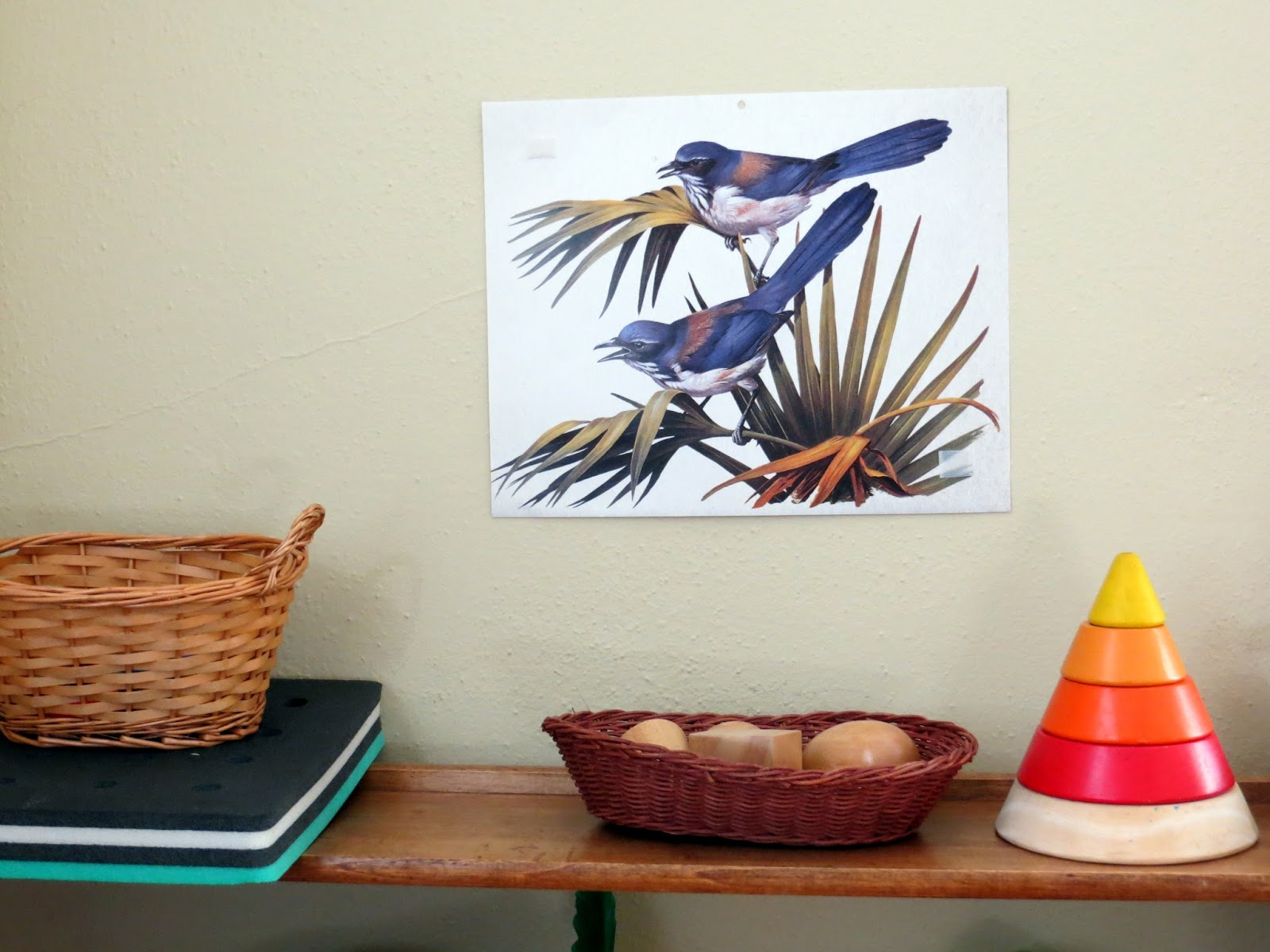
Anyway, now you can put those old calendars to use!  Cut out and laminate the sample images from the back of a calendar to create little cards.  Attach small pieces of sticky back velcro, and put the little cards in a basket.  


Next, cut apart the main calendar pages and attach the opposite pieces of sticky back velcro to the lower, right corners.  Hang the calendar pages all around the classroom/house/wherever.


Ready, set, match!!!

Elise loves running around the house, looking for matches -
it's kind of like a scavenger hunt.  :)

Want to see a blast from the past?
This was a popular activity back in my teaching days - check it out here!

Happy summer, friends!

Tuesday, December 1, 2009

dressing a snowman

Introducing our new felt board friend...

His snowball circles, mittens, scarf, and hat are cut from felt.
{I added the details to the mittens and hat with fabric paint.}
His eyes are beads and his mouth is a bent pipe cleaner.
His arms are tiny twigs from the playground.
His buttons are from a lovely button stash.
And, oh!, I wish I could tell you where his mini carrot nose is from,
but I honestly have no idea.
{It's small enough to be dollhouse food.}


The snowman is fun, but this spinner is the best part.
{The idea for this came from Melissa at Chasing Cheerios.}
I made mine on a circle of white paper, glued to a circle of red paper.
I sketched the quirky little pictures and laminated it
along with a little red arrow made from paper.
I pushed a brad through the center of the circle,
and used a hole punch to cut a circle in the arrow.
{It spins pretty easily!}

The child spins the arrow...


...and outfits the snowman accordingly.
Whether it was done individually or with a partner,
the snowman was dressed over and over all day!

I hope you are all enjoying the holiday season!

Friday, November 13, 2009

a short vowel word game

Who lives in the house of "at?"


Why, bat, hat, mat, rat, and cat, of course!

When doing this lesson,
the child puts all the "at" cards on the house first.

Then she puts the beginning sounds in place,
sounding out each letter combination as she goes.
If she's a writer, she can make a book with the words she's built.

The children can choose from several sets of cards...

"an" {c, p, f, r, m}
"ap" {c, m, n, s, t}
"et" {j, n, p, s, w}
"en" {d, h, m, p, t}
"it" {s, f, m, h, p}
"in" {b, f, p, t, w}
"og" {b, d, h, j, l}
"op" {b, h, m, p, t}
"ug" {b, h, j, m, r}
"ut" {c, g, h, n, r}

I bet you can think of even more short vowel combos, too!

The house part of the lesson is made from felt,
and the cards are hand-written on squares of paper, then laminated.

Someday, when I have a little more time and motivation,
{oh, if only!}
I'd love to post some tutorials on the felts we use for language lessons.
Not only are they useful, they make the lessons so appealing
to little hands!

Monday, October 12, 2009

and suddenly it all made sense

Align Right
The child in this photo has been practicing letter sounds and symbols at school for over 2 years.

He's blended, rhymed, segmented, traced, matched...

I spent the last year searching for new ways to keep him interested and excited about language.

{Sometimes I get fired-up about something - like reading, and I have to remind myself, "Follow the child, Anne, follow the child!"}

Believe me, I was following this child!
He would drop everything to play a language game!
He would invite
me to play language games!
{The kid loves to rhyme so much, he was named "The Rhyme-Master" at the end of the school year potluck.}

The pieces were all there, but they hadn't quite fit together yet...

Until today!!!!!!!!!!!!
He was like a word-building maniac!
{He told me he was going for the Guinness Book of World Records.}

The way he worked - with joy, pride, and purpose,
gave me goosebumps.

I just wanted to share this feeling, and to say,
{I'm sure you already know this!}
it is SO important to have patience with children...
you never know when or where they'll reveal their gifts!

Tuesday, September 22, 2009

the alphabet box

Sometimes I think to myself,
How cool is The Alphabet Box?

26 drawers
{one for each letter}
filled with teeny tiny treasures...

the possibilities are endless!


Here are 2 ways we use The Alphabet Box:

The child chooses a letter drawer
and lays out its contents on a felt.
{The card at the top is also in the drawer
-it's the same as the alphabet story, only tiny.}


A small movable alphabet letter is in the drawer, too.
By moving the letter down the column of objects,
the child "tells the whole story"...
/b/bell, /b/bag, /b/baby, /b/banana


For this second activity,
the child chooses 2 letter drawers.
She places the movable alphabet letters
and the alphabet story cards
at the top of the felt.

She mixes up the objects from both drawers...


....and then sorts them into
the correct columns.
By "telling the whole story,"
she is able to check her work.


**I've never made an alphabet box from scratch - the one in the photo was already in my classroom. I'm always on the lookout for tiny objects to add to it, though. Craft stores, garage sales, and thrift stores are good places to get started. Also, Jo over at A bit of this and a bit of that hosts an awesome phonemic object exchange once a year. As for the box, Hubs just informed me, Oh, those? Pretty much every hardware store has them. (duh) ;)

Wednesday, September 16, 2009

writing in the sand

The children in my classroom love to hone their writing skills in this box of blue sand.

Sand is the perfect medium for beginning writers.


It's more interesting than tracing
sandpaper numerals,
and it's more forgiving than a pencil on paper.

Usually, the children practice writing letters in the sand,
but this child decided that he would rather write numbers.
(Hooray! for thinking outside the box! As I watched him write, I thought, Why haven't I ever done this? From now on, I am definitely going to use the sand for number practice, as-well-as letter practice!)

When a group of friends gathered around the number-writing child,
he effortlessly turned his work into a game...
encouraging them to guess what number he was writing.

It's the best when the children become the teachers!

Friday, August 7, 2009

matching objects to pictures - apples and worms!

I am so excited about my new felt board! As you may know, I am a big fan of felt boards - they are perfect for activities like matching and storytelling. I made this one from a thrifted frame and a rectangle of felt. It's just the right size for little hands to carry to a table, and because it's a frame, I can easily replace the felt. A new felt board, for less than $1 - woo hoo!

Here are some photos of the new apples and worms matching lesson I made to go along with it:

When presenting this lesson to a child,
I would set out all the possible pieces
on a rectangle of felt like this.


Then, I would chose a card...

and make a match!

I would also encourage the child to come up with his or her own combinations, too! :)

Friday, February 20, 2009

the alphabet story

2 friends telling the alphabet story

"Teach the alphabetic principle before you teach the alphabet.

Before beginning formal instruction in letter-sounds, show the child how to use her phonemic awareness to identify an alphabet letter by its sound when the letter is linked with an object or picture. Because the child now understands the alphabetic principle (that letters and speech sounds map onto each other), she is prepared to understand, identify, learn and remember the 26 alphabet letter-sounds."

-Randall Klein, reading specialist & Montessori teacher

I am a huge fan of Randall Klein, and his reading program. Our school's language curriculum is largely based on his materials and ideas. If you ever get a chance to listen to him speak, you'll leave feeling not only wiser, but truly inspired and ready to teach your child to read. The way he explains language development is straightforward, with an emphasis on quick, fun games you can play with your little one basically anywhere. Visit Randall here.

Here's how we tell the alphabet story:
**singing the letter sounds to the tune of "up on a housetop"

a-a-apple, b-b-bird, c-c-cat, d-d-door, e-e-elephant

f-f-fish, g-g-girl, h-h-house, i-i-igloo, j-j-jet, k-k-kite,

lll-lamp, m-m-moon, n-n-nest, o-o-octopus, p-p-pig

q-q-queen, rrr-rainbow, s-s-sun, t-t-turtle, u-u-umbrella

v-violin, w-w-watch, x-marks the spot, y-y-yo-yo so much fun

z-z-zebra he really can run, we just sang our alphabet song,

next time won't you sing along?

For continuity in the beginning, we always associate the same pictures/objects with the letters (for example, "a" is always an apple). As the child becomes more familiar with letters, it's second-nature to associate them with other things that begin with the same sounds.

Wednesday, January 21, 2009

my new favorite game (the children dig it, too)

Here's the gist of it:

You have a child who's at a practicing point in his educational experience. For example, he's got a pretty good understanding of the symbols 1-9 and their quantities, but he doesn't have them quite mastered yet. Or, she knows her letter sounds, and she's really into identifying letter symbols. Maybe, he can match and name colors, but he's not exactly ready to grade them from darkest to lightest. Oh! The possibilities for this game are endless!

Ooops! Back to the gist of it:


Basically, this game is a variation of lessons the child has already done. It's like extreme matching...


Here, the child has set out the numerals from "numerals and counters" on a rug. The counters in this particular lesson are pigs, and we have placed them in a tin on a table across the room. Because I know she knows her number symbols, I point to the 8 and say, "Please bring me this many pigs." If I wasn't sure she was sure of the symbol, I might say, "Please bring me 8 pigs."

It's a fun challenge for the child to be able to go across the room and count out the right quantity of pigs to bring back to the rug.

Here's another variation of the game. A few children and I have placed letter cards on the blue line. The cards are like little books - the letter is on the cover, and inside is a picture of something that begins with that letter. Anyway, I sit across the room, far away from the blue line. I ask each child I'm playing with to bring me a letter (by sound not by name). For example, "Please bring me e." This game would work well at home, too - you could set the cards up in the living room, and then, as you cooked dinner or something, you could ask your child to bring you back certain letters.

This game can be played with all kinds of materials...
color tablets, rhyming objects, matching fabric, sound cylinders...seriously, aren't the possibilities endless?!

Doesn't it sound fun? It is! And, I forgot to say this earlier, it's perfect for the child who just needs to move!

Monday, January 12, 2009

last call for the phonemic object swap!

Jo at a bit of this and a bit of that is organizing a phonemic objects swap! The deadline for signing up is January 14th... so get on it if you haven't already! Here's the gist of the swap:
**you must collect 2 sets of 10 tiny objects (2-10 cm) that begin with sounds from the alphabet
**each participant gets two swap partners, so that means everyone ends up with 20 objects

If this swap sounds like just the thing for you and your little one(s), check it out here.

I'm pretty much beyond excited about this swap. Tiny objects are so dang hard to find sometimes, especially if your goal is to find a few for each letter of the alphabet. Honestly, you can never have too many tiny objects handy to use in language games.

Jo has a great picture in her post of the sound pouches she made. It's really beautiful, and you can click on each letter to see what objects she has in each pouch. In my classroom, we have an alphabet box with a drawer for each letter of the alphabet. Each drawer contains tiny objects that start with that letter of the alphabet. This lesson provides great practice for sound/symbol association. Sometimes children take out one drawer and just look at the objects. Other times, they might take objects from two or three drawers, mix them up, and then sort them by sound. The children in my classroom are really into doing this right now, and they often choose to take out the corresponding sandpaper letters, too. If you don't have something like an alphabet box or sound pouches set up, and you want to make one, this swap would be a good place to start.

Also, tiny objects like these are great to use in "I spy" games, beginning sound games, blending games, and word building activities.

Children have a great love for teeny, tiny things, and we have a plethora of phonemic objects at my school. But, alas, they're all kind of the same... and the children have seen them over and over again. I'm hoping this swap will spice up a few of the lessons in my classroom! I think the children would be thrilled to open up a package of tiny treasures from somewhere else in the world... we could even look it up on the map!

And, hey, maybe you'll get to be my swap partner and I'll send you one of these teeny "h-hats" I've been knitting!

Tuesday, December 23, 2008

a language game

This was going to be part of my "busy hands" post, but it's such a fun (and important) game, I decided to give it its own post!

playing a
blending game
with a teacher

**How to play this game:
Set 3 cards in front of the child, saying what is on each card. Have the child repeat what each picture is of after you say it. For example: "Dog. Please say dog." Next, say, "Please point to d-o-g (saying the sounds of the letters)." They child must then blend the sounds together to figure out which picture you're talking about. To make this game more challenging, put longer and longer pauses between the letter sounds. It's also fun have the child close her eyes, and then, you hide a dot under one of the pictures. "The dot is hidden under the d-o-g." An abstract version of this game could be played without pictures. "I'm thinking about something, and I'll give you a clue to see if you can figure it out. I'm thinking about a d-o-g. " When the child is able to tell you the sounds she hears in words, she's now segmenting. Segmenting is the key to reading success!

Tuesday, November 25, 2008

creative writing 101...


The inspiration for this lesson came from refrigerator magnet poetry.

I love that stuff!


This lesson is mostly for the older ones in my classroom - the beginning readers.

The "Bob Book" readers.

I wanted to give them extra practice with
capital letters at the beginning of sentences,
useful words like the, his, and my,
spaces
between words,
and
punctuation
at the end of sentences.

This lesson also provides
a little writing practice
and an opportunity to read for meaning.


Pink words go first,
orange next,
then green,
and finally a black period at the end.
(There's no particular reason for these colors
other than that was the paper I had to choose from :)
It doesn't matter which words the child chooses
as long as they're in this order.

The words are laminated
and stuck to magnets.
I also made a color-coded line
for the children to use as
a control
for their word order.

Friday, November 21, 2008

matching pictures

Have you noticed how into matching I am lately?
The children LOVE matching lessons.


Especially this one...


I cut apart a calendar that I discovered last weekend...

hidden at the bottom of a box full of random treasures.
Is it strange to save calendars for multiple years past their expiration date?

I think not! Look at what a perfect use I finally found for it!

How to make it:

1. Cut apart all the mini pictures from the back of the calendar.
2. Cut apart the main pages of the calendar.
3. Laminate the whole lot of it.
4. Stick a square of velcro (rought side) to one corner of each big picture.
5. Stick a smaller square (soft side) to the center of each mini picture.
6. Hang the big pictures everywhere and put the mini pictures in a
a basket that's fun to carry.
7. Watch the children carry the basket...

all over the classroom
matching pictures
all morning long!


* You might want to check cubbies before the children go home for the day - the mini pictures proved to be quite swipe-able! :)


Related Posts Plugin for WordPress, Blogger...